
Dental Bridges – Weyauwega, WI
Where Complete Smiles Are Achievable

At the dental office of Dr. William Twohig, we don’t reach for restorations that contain metal when rebuilding a patient’s smile. Instead, we trust the durability of all-ceramic materials – a more natural solution that provides strength and aesthetics when filling in the gaps left behind by multiple missing teeth. Our dental bridges in Weyauwega are lifelike and long-lasting, so patients can feel good about the way they look while also remaining confident in the health of their smile. If you are looking for a way to replace your missing teeth, schedule a consultation with our team today!
What is a Dental Bridge?
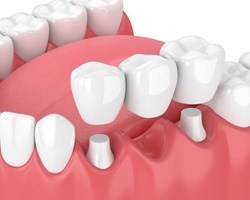
A dental bridge is a custom restoration that is designed to fill in the gaps of your smile while also improving your aesthetics and your ability to eat and speak without difficulty. It’s generally used when no more than four consecutive teeth are missing in a row along the upper or lower arch of the mouth.
Types of Dental Bridges
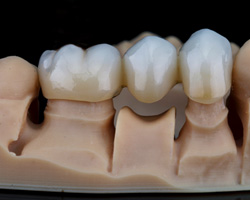
You will discover in your consultation with Dr. Twohig that there are two types of dental bridges you can choose from: a traditional fixed bridge or an implant bridge. Which one you will need requires an examination from our team and a discussion about your budget and smile goals.
Traditional Dental Bridge
After a tooth is extracted, neighboring teeth will quickly begin to shift into the open space as a way to compensate. To prevent this, dental bridges can effectively fill that space with a crown on either side (both of which are anchored by altered neighboring teeth) and a series of false teeth that fill the gap, or pontics.
Implant Bridge
An implant bridge may look similar to a traditional one; however, the main difference is the dental implants that are used. Instead of altering healthy abutment teeth, this solution requires placing two implant posts into the jawbone, allowing them to fuse with this area of the facial structure. When ready, the custom bridge will then be snapped into place on top of the implants.
What Are the Benefits of Getting a Dental Bridge?

Choosing a dental bridge to rebuild and restore your smile is a worthwhile decision and investment, one that will help you enjoy a better quality of life than before. You will notice that:
- You smile more confidently because you have a full set of teeth
- Your oral health improves by keeping natural teeth firmly in place instead of drifting out of alignment
- You lower your risk of jawbone resorption when you choose an implant bridge
- You can easily clean and maintain your restoration
- Your artificial teeth can last 15 years or more (traditional bridge) or 30+ years (implant bridge)
- You’ll enjoy a more natural-looking, youthful appearance
Dental Bridges FAQs
How Long Should a Dental Bridge Last?
The lifespan of a dental bridge in Weyauwega can vary significantly. Some bridges need to be replaced after 5 years, but others can last for 15 years or even longer.
When it comes to the longevity of your dental bridge, the most important factor is the care you give it. If you want to keep your current prosthesis for as long as possible, you need to make a point of practicing good oral hygiene and breaking bad habits such as nail-biting.
Bear in mind that a dental bridge placed toward the back of your mouth may wear down slightly faster than one at the front of the mouth. This is due to the extra pressure that the prosthesis will be exposed to when you chew your food.
How Many Teeth Can a Dental Bridge Replace?
A dentist in Weyauwega can use a dental bridge to replace up to four teeth in a row. That said, it’s important to note that longer bridges are often less stable. For this reason, traditional bridges are typically only used to replace one or two teeth. Implant bridges are generally a better choice for replacing three or four consecutive teeth due to the stability offered by the implant posts.
How Do I Clean Under My Dental Bridge?
One way to clean the area under your dental bridge is to use a floss threader. This item can help guide a piece of traditional dental floss under your prosthesis. Then you can simply slide the floss back and forth to get rid of bacteria and food debris.
If you have trouble using a floss threader, you may want to consider an interdental brush or a water flosser instead. Both can be effective tools for cleaning the areas in your mouth that you can’t reach with a toothbrush.
Remember, cleaning under your dental bridge is essential if you want to keep it for as long as possible. If harmful bacteria are allowed to accumulate in the area beneath the prosthesis, they could eventually cause cavities in the teeth supporting the bridge. Untreated tooth decay is a significant risk factor for dental bridge failure.
Are Dental Bridges Covered by Insurance?
Most dental insurance plans will indeed help pay for a dental bridge. Coverage is often around 50% since getting a bridge is considered to be a major restorative treatment. Of course, this percentage can vary based on what plan you have. Additionally, the amount you need to pay out of your own pocket for a dental bridge can be influenced by a number of factors, such as whether you’ve met your annual deductible.
You can always call your insurance company to confirm the specifics of your coverage. Alternatively, you’re welcome to ask our team any insurance-related questions you have; we care about making sure you have all the information you need to get the most out of your benefits.